Sunday, April 1, 2012

My Chai

Well, I originally started making my own Chai from a "pin" that I saw, but now the link says that that page does not exist any more.  I guess credit isn't necessary because I have made so many changes to the recipe, but here's the link if it is ever working again.
http://www.inwardfacinggirl.com/blog/2011/11/1/give-it-a-whirl-krishna-tea.html

The recipe was good, but it called for a lot of ground spices and loose tea which ended up as a big pile of sludge once you strained the tea.  It was actually difficult to strain.  It also called for a few whole spices, which were thrown away with the sludge spices.  I thought, what a waste, couldn't these spices be reused?  Well, yes, they can.  I have been using mostly whole spices in tea balls to make this recipe.  So far I have reused the whole spices in tea-balls about 5 times and the flavor is still good.  I rinse the tea-balls with clean water after each use.  Since the recipe does have milk, I don't want that sitting in with the spices.


So, this is how I make the perfect cup of Chai tea.

Place in pan on the stove:  4c. of milk and 3 c. of water.  Bring to a slow boil.  You should stir it often or the milk will start to stick to the bottom of the pan. 


Put into two tea-balls heaping portions of:
(The teaballs are those two little mesh things.  I got them at Walmart.)
1 tsp. of whole peppercorns
1 Tbsp. of whole cloves
1 tsp. of whole allspice
1 tsp-size chunk of peeled whole ginger root.

It doesn't matter which spices you put together, they just won't all fit in one tea-ball.  I'll be honest, I didn't really measure very well.  1 Tbsp of peppercorns was too peppery for me, so that I did decrease, I know.

Once the milk/water mixture is super hot, add:

5 Tbsp. sugar (you could decrease this and add another sweetener before drinking to your taste.)
4 regular teabags
1 tsp. cardamom (I didn't have this for a while and the Chai was okay, but it definitely is worth having.  It is very expensive, but I got some from Vitacost with my $10 refer a friend code.) 
1 tsp. cinnamon
The two tea-balls with whole spices in them.


 Keep it at a barely boil or low boil for about 5 - 6 minutes.  You want it really hot to get all the flavors. I tried making a single cup by pouring boiling water over the two tea-balls and adding lesser amounts of the other spices/sugar and the water just wasn't hot enough.
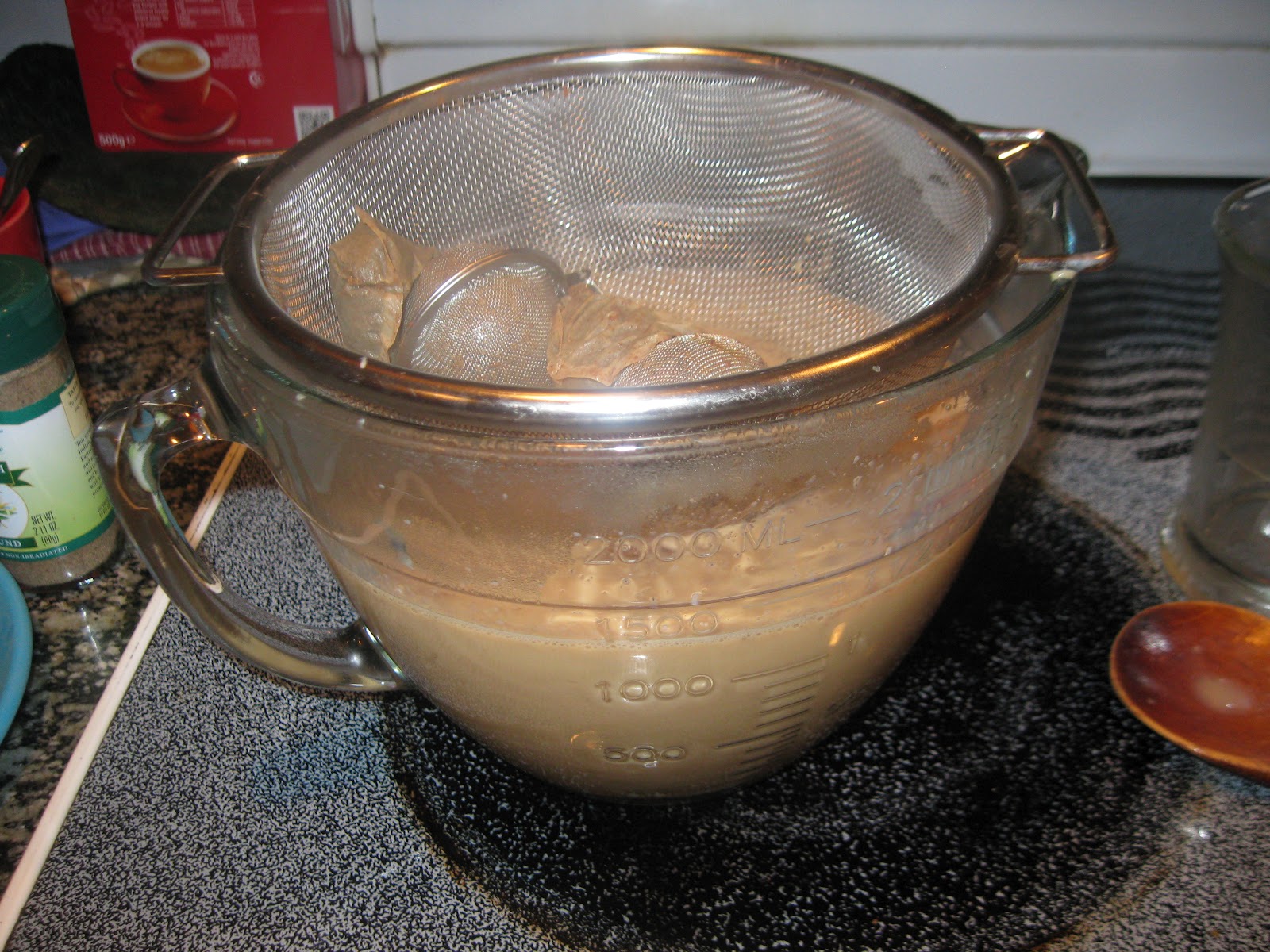

Pour the liquid through a strainer.  I'm not sure I really must do this anymore, I could just fish out the tea-balls and teabags and leave the cardamom and cinnamon in.  Rinse the tea-balls in water.  You may even want to carefully open them and rinse off the spices inside (I have not and it has been fine.)  I put the tea-balls with whole spices in a dry cup to use another time.  Throw away the teabags (I'm not that frugal.)


Drink your nice cup of hot Chai!  Enjoy!

You can put any extra Chai in a container in the fridge to heat and drink at another time, or share a cup with a friend. 

(An update:  I have been making this lately with just cloves and peppercorns in a teaball, then 1-2 t. ground cinnamon, and 1 heaping t. cardamom.  I have also been using Stevia instead of sugar.  A t. of vanilla is tasty too!  I have just been putting the pot of milk/water on the stove, throwing everything in and letting it simmer, stirring occasionally.  ) 


Here's the quick-look / print recipe:

Perfect Homemade Chai by Amy

Place in pan on the stove:
4 c. of milk
3 c. of water
Bring to a slow boil, keep stirring.

In two tea-balls place heaping portions of:
1 tsp. of whole peppercorns
1 Tbsp. of whole cloves
1 tsp. of whole allspice
1 tsp size chunk of peeled whole ginger root.

Once the milk/water mixture is super hot, add:
5 Tbsp. sugar  
4 regular teabags
1 tsp. cardamom
1 tsp. cinnamon
The two tea-balls with whole spices in them.


Keep it at a barely boil or low boil for about 5 - 6 minutes. 

Pour the liquid through a strainer or fish out the tea-balls and teabags and leave the cardamom and cinnamon in.  Rinse the tea-balls in water.  Throw away the teabags.  Refrigerate any extra Chai and reheat as desired.


Monday, March 12, 2012

Early Garden

I want to document my garden /gardening this year.  I have a lot of people who ask me what I do for my garden.  They usually ask when it is in full-swing and then I can't even remember what I did and why.  Also, there is always some issue every year and if it recurs I like to know what I did about it in previous years!  So that's another good reason to document.  Be warned,  I don't do things necessarily the way most people do.

I started some seeds in early March (it is still early March).  I did take some pictures, but that camera is currently battery-dead so I will have to download and explain that in a later post.

Today is a glorious day, so I went out and turned over one garden and planted lettuce.  That is a "cold" crop, meaning it can handle a frost and is okay with cold (although I may put plastic or a fishtank over them to help germinate if this weather doesn't hold out.)  There are other cold crops - peas, spinach, cauliflower. etc. (mostly veggies my family won't eat.)  Check the back of the seed packet and it tells you whether you can plant in early spring before the last frost.

This is the garden that I have NOT turned over yet.


I cleaned out my goat shed this weekend and just plopped the piles in the planting areas of my garden.  The blue tarp is in the walkway.  This is how I compost.  I just stick the poo/hay/leaves/whatever organic material on my garden and ignore it.  I have some older piles from the fall clean out that have been breaking down all winter.

Below is the garden I turned over today.  It looked similar to the above, but the piles had decomposed almost completely into compost.   I turned over what was composted into the soil beneath and then raked the uncomposted material back into 2-3 piles.   Mostly hay that is still mucky.  This is similar to turning a compost pile.  It introduces air into pile and assists the composting process.  Those piles will most likely stay there and then be worked into the soil later, maybe even next growing season.   The piles in my above garden will breakdown quite a bit in the next 2-3 months and I will turn over those and rake up any uncomposted material in that garden in mid-May.


My reasons for composting this way are: 
a) The soil under the compost pile is always the best  and most productive soil.
b) I don't have to build any special structure to hold / maintain the compost.
c) I have so much organic material that I don't have to be selective about where I put it.
d) Turning over the compost is easier because you don't have to reach underneath it. You can just rake it to another area, leaving behind rich soil. 


Monday, March 5, 2012

Chicken Soup from Scratch (and other leftover chicken recipes)

My daughter is home from college and so I made a roast chicken last night for her.  Generally, the day after a roast-chicken, I make chicken soup.  Since a friend asked me recently what my "secret" was to making chicken soup.   I thought I would blog my process / recipe.

First, roast a chicken.   You could also roast split chicken breasts or thighs and legs.  Don't use boneless.   My personal theory is that the fat of the skin and the gelatin of the bones adds something to the broth.  There is no scientific support for this theory, but I do know that boneless chicken breasts do not make a good broth.  It also has a different quality if you just go straight to boiling it.  Roast it first.


Then eat it.   We just eat what we want and leave the rest on the carcass.  If I am roasting chicken pieces, I may roast a few extra to use exclusively for soup.  But generally, I think soup is a good way to use all that undiscovered meat after eating a roast chicken.


Take the picked-over carcass and stick it into your crock pot covered with water on low overnight.  You can also put it in a large pot on your stove and boil/simmer it for several hours until it all falls apart.


 In the morning you should have a pile of disconnected bones, cartilage, skin and meat.

Pour off the broth into a large pot (I use a metal colander to catch any falling pieces.)


Then separate the meat from the bones, fat, and "stuff".   I usually wait for everything to cool at little.  Some people might find this skeevy, but this is where chicken soup comes from.  I think we are far too removed from our food.  These are all the parts of a chicken.  My uncle used to suck the marrow out of the bones, which I thought was gross.  But perhaps we would be less wasteful if we knew all the quality nutrients we were just throwing away. 


In our house, there is usually a lot left on the carcass, so I put some meat into the pot of broth and then have two containers or a plastic bag that I put some in and freeze for later use.  


I scooped about 1 c. of broth into each extra container and then topped off with water, maybe another 1/2 c.   Those will go into my freezer for future emergency soup needs.   I also may use my leftover frozen chicken and broth for Chicken Enchiladas, Chicken Pot Pie, or Chicken and Dumplings.  I'll post the recipes below.  


I added about another 8 c. of water to the pot and about 4 bouillon cubes.  Is that cheating?  I think of it as adding flavored salt.

Peel and chop about 3 carrots, and chop 3 celery stalks. 


Add to the pot and simmer.  At this point, I just let the whole thing simmer for the rest of the day.  I think the veggies take about 1/2 hour or so to get tender, but simmering longer allows all the flavors to meld in my opinion. 

About 10 - 15 minutes before serving, I add the noodles.   Usually about a cup or 1/2 a bag of noodles is more than enough.

You can use anything really.   I usually use egg noodles, but I have also used leftover pasta.  You could use leftover rice too.


Your soup is ready to serve!


Homemade Chicken Soup

1 chicken carcass or about 3-4 lbs of chicken parts - roasted in the oven.
3 carrots, peeled and chopped.
3 celery stalks, chopped
10-12 cups of water, divided
4 bouillon cubes (optional)
1 c. of noodles (or 8 oz - 1/2 bag)

Cook carcass covered in water, in a crock pot overnight or on your stove top for several hours until falling apart.  Allow to cool.  Pour off broth into a large cook pot.   Separate meat from bones, skin, and other inedible parts.  Put meat into pot of broth, or separate into containers for future use.  Place chopped vegetables into pot and simmer for hours or until veggies are tender.  Add noodles about 10 minutes before serving.  At any point, you can skim the chicken fat off the top of the pot if it is too oily. 

Here is the Enchiladas recipe.  Our dear Columbian friend, Dedie, used to make these for us.

Chicken Enchiladas  by Dedie Belliveau

12 corn or flour tortillas
1 - 2 T. oil
2 c. grated cheddar cheese
1 lg. onion, chopped fine
1 lb or so of cooked chopped chicken (or turkey!)
2 c. chicken broth
1/4 cup flour (or Wondra - no lumps!)
1/2 t. salt
sliced jalapenos to taste (fresh or pickled)
1 - 8 oz. sour cream

Soften tortillas in a hot oil in skillet (you don’t have to do this with the flour tortillas – they are soft enough to roll).  Saute’ onion until soft.  Mix together cheese, onion and chicken in a bowl.  Spoon onto tortillas; roll to enclose filling.  Place in greased 9x13 pan.  In a saucepan, blend broth, flour and salt.  Cook until thick, stirring constantly.  Add jalapenos.  Blend in sour cream.  Pour over the tortillas.  Bake at 350ยบ for 40- 45 min. or until bubbly.  I have also made up just the rolled tortillas and frozen them in freezer bags for a later time. 

The recipes for Chicken Pot Pie and Chicken and Dumplings are both from Food.com.  They are tried and true (by me! and others I am sure.)  There were many other less or unsuccessful attempts with other recipes prior.   These recipes are easy (non-processed easy) and they are delicious.

If I am not particularly feeling like 2 nights of soup, I may even divide the pot of broth / meat in two and use it for a second night of pot pie or chicken and dumplings.    Turn your roast chicken into a 3 day meal!

http://www.food.com/recipe/delicious-chicken-pot-pie-10744

http://www.food.com/recipe/chicken-and-dumplings-like-cracker-barrels-5000

Thursday, March 1, 2012

Make Your Own Taco Seasoning

Since I have started on Pinterest, several people have asked me about recipes and gardening tips.  I don't really think much about what I do, I just do it.  So, I decided I would start blogging and pinning some of the things that are now just second nature to me....like gardening, making bread, milking goats, etc.....saving bread crumbs.

Sorry, no spiritual insights today ;)

But, you can make your own Taco Seasoning.  My mom used to buy those $1- each packets (probably .69 back then) all the time and it was all I knew, so that's what I bought too.  Now I make my own large batch of it and store it in an old spice container.  I use about  1-2 T. per pound of ground beef for tacos, or just use it to taste for other recipes.

I buy most of my spices from Job Lot or Price Rite, but if you want to be even healthier / natural / organic, you could get the higher quality spices, or use your own.  I do use my own hot pepper flakes.


That is NOT the cumin container, it's an old chili powder container that I am reusing. 


This recipe is roughly based on the recipe in Saving Dinner the Low-Carb Way by Leanne Ely.

Homemade Taco Seasoning

1 cup dried minced onion
1/3 c. chili powder
3 T. cumin
3 t. red pepper flakes (she calls for 4 t., but mine are super-hot.)
1 T. oregano
4 t.  garlic powder
2 t. onion powder

Mix together and store in airtight container.


Thursday, February 23, 2012

Lessons from Roger Williams

I am reading to my 9 year old a little book called Once Upon a Time in RI which was written in 1914.  It is not a first source or anything; it’s just a collection of historical stories (true stories, it says) telling of some major events in the founding of RI for children. 

I am only in the second chapter, but I think that modern Christians have much to learn from Roger Williams.  I think some have forsaken the priority and call to share the gospel and love the “heathen” and are instead trying to use government power to force what they perceive as God’s agenda upon them. 

Christ’s love is much more powerful.  I am not saying that Christians shouldn’t run for office or vote or advocate their position. I am just saying that forcibly imposing our will through government....even if it is in keeping with God’s standard, was not God’s chosen way for “change”.  His chosen way was Christ and the gospel. 

Roger Williams had the same issues,  “Moreover, the Puritan rulers in Boston allowed the Magistrates there to punish people not only for breaking the laws about lying and stealing and so on, they also had the right to punish people for not going to church, or for breaking the Sabbath day, or for not believing as the Puritan ministers taught them.  This seemed to Williams very wrong.  He did not think the magistrates could have any such power as that.” 1  Instead, Williams “busied himself with teaching and preaching, and also began to seek out the Indians and make friends with them.” 2

He spent much of his time with the Indians.  He wasn’t reveling in or approving of their sin, unbelief, etc. but sharing Christ with them with his very life.  They seemed to welcome him.  He had respect for them.  One thing that got him into trouble with the Governor was that he believed that all the land belonged to the indians, and only they had the right to sell or give away portions of land, not the King of England. 

And let’s not say that Williams was some wishy-washy Christian, his true agenda was the gospel, that is clear.  He wrote and lived the truth and challenged the establishment’s doctrine.....sounds a lot like Luther.

I wonder how much further we would get in “encouraging” righteousness in our society, if we took our time to seek out the lost and live among them, invited them to our tables or dined at theirs, learned their language, and respected their rights as people.  I know there are Christians out there doing just that, many, many of them. Unfortunately, they are not the Kings and Governors and Puritan rulers.  So I guess this is a thought for the leaders and talkers who are called Christian.  

I know there is truth to be defended, consequences to curtail, Christian persecution to consider, but we cannot coerce people to believe as we do. Do we really want to use the government to do so?  (This goes both ways, do those who do not believe as we do, really want to use government to force us to believe what they do?)   
Even those things that are no-compromise issues for us - abortion for example.  How was it that the barbarians and savages of old stopped sacrificing their babies to their gods?   Missionaries came.  Missionaries were martyred.  Savages came to Christ and stopped killing their children.  That’s the power that changes.  Not government laws or edicts.

Why not try Roger’s way?  Why not try Christ’s way?


1  Once Upon a Time in RI by Katherine Pyle pg. 24-25
2 Ibid  pg. 22

Tuesday, February 14, 2012

Waste Not


So, I got this cookbook for Christmas called "More-with-Less".   A friend and mentor of mine when I was in college cooked from it all the time, but we were a "Fanny Farmer" cookbook family, so I never thought much again about this cookbook until I read three or four blogs where the individuals used recipes that came from the book.   So I asked for it for Christmas and now this waste not post.


It always really gets to me when I go to dinner parties or gatherings where people throw away perfectly good food!  I watched a friend of mine throw away about a pound of fresh vegetables off of a veggie tray into her trash can.  I tried not to gasp!  Well, after reading this book, I realized how very wasteful I was being myself.  I would buy fresh herbs for a recipe, which would of course, go bad in my fridge after I had used what I needed.  Heels of bread would mold in the bread basket until they weren't even acceptable to feed the chickens.  


At the end of each chapter of More-with-Less is a section called "Gather Up the Fragments".  I have been trying to follow this advice, although I haven't quite grasped how to use the meat scraps.  However, I probably have made about 3 cannisters' worth of perfectly good (better than store-bought) bread crumbs and cubes from my bread scraps.  Can you believe I was just throwing away the stumps of my home-made bread!  For shame! 

I save all of my bread ends, old (but not moldy) bagels, rolls, etc. and throw them in a bag in my freezer.  (This bag is not truly representative as I didn't think to take pictures of my first batch, but you get the idea.)


When I have a good amount saved, I cut any chunks into slices and put them on a cookie tray to toast in the oven. 


Then I put the toast into my food processor.  Some of it comes out a little chunky, and some of it comes out as crumbs.  The chunky pieces I can use for stuffing (which I make maybe once a year.)


Here's my step-mother's grandmother's recipe:  

Kate Larsen's Bread Stuffing 
(this got rave reviews from the cooks in the kitchen at our church Thanksgiving dinner...).

1 large loaf of white or wheat bread- leave out to get stale for about two hours...
OR substitute the leftover bread-end, bread cubes from your freezer! 
Cut into cubes or use as is if small enough.
Place in large bowl and moisten with a little water or broth (enough just to moisten - about 1 - 1 1/2 cups?)
Add to bread:  1 medium onion chopped fine, 1 stalk celery chopped fine, LOTS of fresh Parsley (don't use dried, this is the secret ingredient that makes this fabulous - use the whole bunch!),  6-8 stalks fresh thyme  (dry is fine for this ing. about 1/2 t.),  1 1/2 t. salt, 1/4 t. pepper, and about 3-4 eggs, enough to make it bind.  Mix well with your hands and stuff it in your turkey/chicken or bake it in a covered dish. 


I use the crumbs for any breaded recipe.

Like Eggplant Parmesan - I made extra and put that in the freezer too.


I have also been drying any leftover herbs that I buy on a nail above my sink and I have been freezing any veggies that are not going to be used in the immediate future....except lettuce, of course.  

Maybe next I can render the fat I cut off of our meats to make my soap?  Nah. 


Wednesday, February 8, 2012

More Insights from Laura Ingalls Wilder

I am reading aloud to my daughter, "These Happy Golden Years".  In the beginning of the book, Laura is teaching at a school about 12 miles from her home and boarding with a man and his wife while she teaches the school for, I believe, 8 weeks.  The wife is sullen, rude, silent and brooding.  She does not speak to Laura at all, even though Laura tries to be pleasant to her.  The wife even threatens to kill her husband one night with a knife if he won't take her home back east.  Granted, the homestead winter was not easy, but the contrast between Laura's time with this family, and the Long Winter with her own family, is sharp.  Laura refuses to complain about her time out with the Brewsters because she knows her family needs the money to keep Mary in college, even though her very life may be in danger.

She is so overjoyed and thankful at the end of the term, when she returns to her own peaceful home.  There is nothing amazing about their home, but Laura's love for her parents and their mutual love and respect for each other sits in sharp contrast to the Brewsters' home.

This morning, I read this scripture:

"Better a little with the fear of the LORD
than great wealth with turmoil.

Better a meal of vegetables where there is love
than a fattened calf with hatred."

- Proverbs 15: 16-17

Although the Brewsters fed Laura sufficiently, the food was flavorless; the atmosphere was heavy in the little claim shanty.  She could not break the sullen weight of that disgruntled wife.

Her home with Ma and Pa and her siblings was peace and joy.  They never seemed to get ahead materially, but they made do and were thankful for the little they had, even if it was the blackbird pie that they made from the blackbirds that ate their entire cornfield.

It was like the perfect story-picture of this proverb.

Then I thought, how is the atmosphere in my home?  Are my children and husband ecstatic to be at home?  Is there fear of the Lord and love in my home?  or turmoil and strife?

I'd like to think that I have a peaceful and joyful home, but it is something to continually strive for.  Circumstances can so often bring turmoil, and those circumstances are so often financial.  It's funny that the Proverb not only contrasts love and hatred, but plenty and want - with plenty on the side of hatred, and want on the side of love.

It is best to be content with little, and not to allow the fear of want to squander the faith and love in our homes.